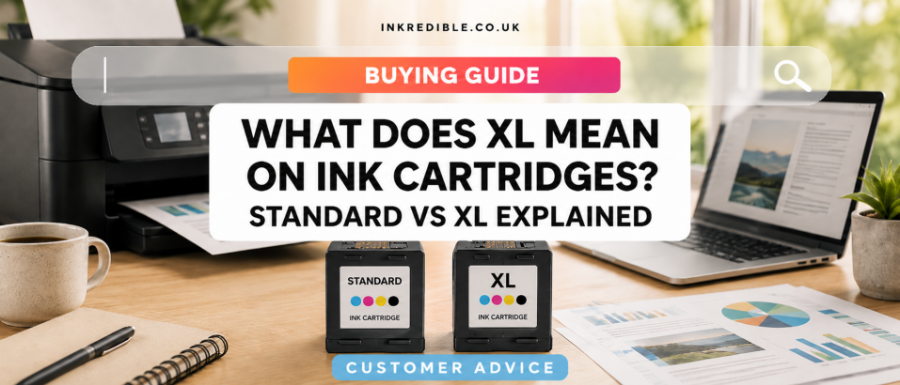
If you've ever shopped for printer ink, there's a good chance you've seen two cartridges that appear almost identical, except one has “XL” written after the cartridge number.
For example, you might find a standard cartridge alongside an XL version designed for the same printer. The XL cartridge normally costs more, which naturally raises a few questions: What does XL actually mean? Will it fit my printer? Does it contain more ink, and is it better value?
In this guide, we'll explain the difference between standard and XL ink cartridges, why XL doesn't necessarily mean a physically larger cartridge, and how to decide which option makes the most sense for your printing needs.
What Does XL Mean on an Ink Cartridge?
On printer cartridges, XL usually means high capacity or high yield.
An XL cartridge is designed to print more pages than the standard version of the same cartridge range because it generally contains more usable ink.
Although the letters “XL” might suggest an extra-large cartridge, this does not usually mean that the cartridge itself is physically much larger, although there are some exceptions..
In simple terms: a standard and XL cartridge designed for the same printer will usually fit into exactly the same cartridge slot. The XL version simply offers a higher ink capacity and therefore a higher potential page yield.
Standard vs XL Ink Cartridges: What's the Difference?
The main differences are normally ink capacity, page yield and purchase price.
Standard Ink Cartridge
- Lower initial purchase price
- Contains less usable ink
- Lower estimated page yield
- May suit people who print only occasionally
- Needs replacing more frequently if you print regularly
XL Ink Cartridge
- Higher initial purchase price
- Usually contains more usable ink
- Higher estimated page yield
- Often offers a lower cost per printed page
- Needs replacing less frequently
The important point is that higher purchase price doesn't necessarily mean higher printing cost. An XL cartridge may cost more to buy, but if it produces considerably more pages, it can work out cheaper over its usable life.
Will an XL Ink Cartridge Fit My Printer?
If the manufacturer lists both the standard and XL versions as compatible with your exact printer model, then yes.
For printers that support both versions, the cartridges are designed to fit the same cartridge holder despite the difference in capacity.
However, you should never assume that an XL cartridge will fit simply because the cartridge number looks similar.
Printer manufacturers produce many cartridge ranges, and a difference of just one letter or number can indicate a completely different cartridge.
Always Check Your Exact Printer Model
Before ordering either a standard or XL cartridge, check that your exact printer model appears in the cartridge compatibility information.
Don't rely purely on the appearance of the cartridge or a similar model number. Two cartridges can look almost identical while being electronically or physically incompatible with different printers.
Does an XL Cartridge Contain More Ink?
In most cartridge ranges, yes. The purpose of the XL version is to provide a greater usable ink capacity and therefore a higher page yield than the standard cartridge.
The exact difference varies considerably between cartridge ranges and manufacturers.
Rather than judging a cartridge by its physical size, look at its stated page yield.
Page yield is the manufacturer's estimate of approximately how many pages a cartridge can produce under specified testing conditions.
Remember: real-world page yield will vary depending on what you print. Photographs, graphics and pages with large blocks of colour use considerably more ink than lightly covered text documents.
Are XL Ink Cartridges Better Value?
For many regular printer users, they can be.
Although an XL cartridge usually costs more initially, the higher page yield can mean that each printed page costs less.
The best way to compare two cartridges is therefore not simply to look at the selling price. Instead, compare the cost per page.
You can calculate this by dividing the price of the cartridge by its estimated page yield.
Cartridge price ÷ estimated page yield = approximate cost per page
This can make the difference between standard and XL cartridges much easier to understand.
For somebody who prints frequently, purchasing the higher-yield option can also mean fewer cartridge changes and fewer occasions when the printer unexpectedly runs out of ink.
When Might a Standard Cartridge Be the Better Choice?
XL isn't automatically the best choice for every customer.
A standard cartridge may make more sense if:
- You print very occasionally
- You only need the printer for a small number of documents
- You expect to replace the printer in the near future
- You prefer the lowest possible upfront purchase price
- You don't want ink sitting unused in an inkjet printer for a long period
If you print only a handful of pages each month, buying the maximum possible ink capacity isn't necessarily required.
For occasional users, the standard cartridge may provide more than enough ink while keeping the initial cost down.
When Is an XL Cartridge Usually the Better Choice?
XL cartridges tend to make the most sense for people who print frequently.
This could include:
- Home workers
- Small businesses
- Students printing coursework or notes
- Families using one shared printer
- Anyone regularly printing documents, invoices or correspondence
If you already find yourself replacing standard cartridges regularly, moving to the XL version can reduce how often you need to buy and change cartridges.
Does XL Ink Improve Print Quality?
Not necessarily.
The main advantage of an XL cartridge is capacity rather than print quality.
If a standard cartridge and XL cartridge belong to the same range and contain the same type of ink, you would normally expect broadly comparable print quality from both.
The XL version is intended to keep you printing for longer rather than make each individual page look better.
Do XL Cartridges Last Longer?
They normally last longer in terms of the number of pages they can print.
However, there is an important distinction between page yield and how long a cartridge lasts in months or years.
If you print regularly, the greater ink capacity of an XL cartridge should mean you can print for longer before replacing it.
If you hardly ever print, however, inkjet cartridges can remain installed for long periods and the printer may carry out automatic cleaning routines, which also use a small amount of ink.
So an XL cartridge isn't necessarily twice as useful simply because it contains substantially more ink. Your own printing habits matter.
Can I Mix Standard and XL Cartridges?
With many printers that use separate cartridges, it may be possible to have a mixture of standard and XL cartridges installed at the same time, provided every cartridge is listed as compatible with that printer.
For example, somebody who uses a lot of black ink but relatively little colour may choose a higher-yield black cartridge while continuing to use standard-capacity colour cartridges.
Compatibility is the important factor, not whether every cartridge has the same capacity designation.
Check before ordering: cartridge systems differ between printer manufacturers and models, so always confirm compatibility for your exact printer rather than assuming all standard and XL combinations will work.
What About Compatible XL Ink Cartridges?
As well as original manufacturer cartridges, many printer models have compatible or remanufactured alternatives available in both standard and high-capacity versions.
A good-quality compatible XL cartridge can provide another way to reduce printing costs, particularly for users who print regularly.
As with any replacement cartridge, the most important thing is to ensure that it has been designed specifically for your printer model.
Use the INKredible website search and enter your exact printer model number. Our individual printer pages show the ink cartridges that are specifically compatible with that printer, making it much easier to compare available standard, XL and compatible options without accidentally ordering a cartridge for a similar-looking model.
Standard or XL Ink: Which Should You Buy?
There isn't one answer that suits every printer owner.
If you print regularly, the higher page yield of an XL cartridge can make it more convenient and may provide a lower cost per page.
If you print only occasionally, a standard cartridge may provide all the ink you need while keeping the initial purchase price lower.
The best approach is to compare:
- The cartridge price
- The estimated page yield
- How regularly you print
- Whether both cartridges are compatible with your exact printer
Most importantly, don't assume that “XL” means you need a larger printer or that the cartridge won't fit. When both versions are designed for your printer, XL generally refers to more printing capacity rather than a completely different cartridge size.
Frequently Asked Questions About XL Ink Cartridges
XL normally identifies a higher-capacity or higher-yield version of a printer cartridge. It generally contains more usable ink and is designed to print more pages than the standard version.
Not in most cases, although there are exceptions. In many cartridge ranges, standard and XL cartridges are designed to fit exactly the same printer cartridge slot. XL generally refers to the amount of usable ink or page yield rather than simply the external dimensions of the cartridge.
In some cases, for example some Brother printers and occasionally HP printers, the cartridge slot is capable of accepting a standard cartridge and a physically bigger XL cartridge. If you do receive a physically larger XL cartridge or toner, it is usually because your printer does have the capability to accept both physical sizes. This may require a slightly different installation method i.e. the standard size cartridges might install in the centre of the cartridge slot whereas a wider XL capacity cartridge still installs centrally but takes up all of the remaining room at either side.
Yes, if the XL cartridge is specifically listed as compatible with your printer model. Always check compatibility before ordering because similar cartridge numbers are not necessarily interchangeable.
They can be particularly worthwhile for regular printer users because their higher page yield often means fewer cartridge changes and potentially a lower cost per printed page. Occasional users may prefer the lower initial cost of a standard cartridge.
XL normally relates to ink capacity rather than print quality. Standard and XL cartridges from the same cartridge range should generally provide comparable print quality when used correctly.
This is possible with many printers that use separate cartridges, provided both cartridges are individually compatible with your exact printer. Always check the cartridge compatibility information first.
Final Thoughts: Don't Choose on Price Alone
When comparing standard and XL ink cartridges, it can be tempting to choose whichever has the lowest price shown on the product page.
But the cheapest cartridge to buy isn't always the cheapest cartridge to use.
An XL cartridge will normally cost more upfront, but its higher page yield can make it better value for regular printing. A standard cartridge, meanwhile, can be perfectly suitable for an occasional printer user who doesn't need the additional capacity.
Whichever option you choose, always start by searching for your exact printer model. That way you can compare the cartridges genuinely designed for your printer rather than relying on similar cartridge numbers or search-engine results that may lead you to the wrong product.